
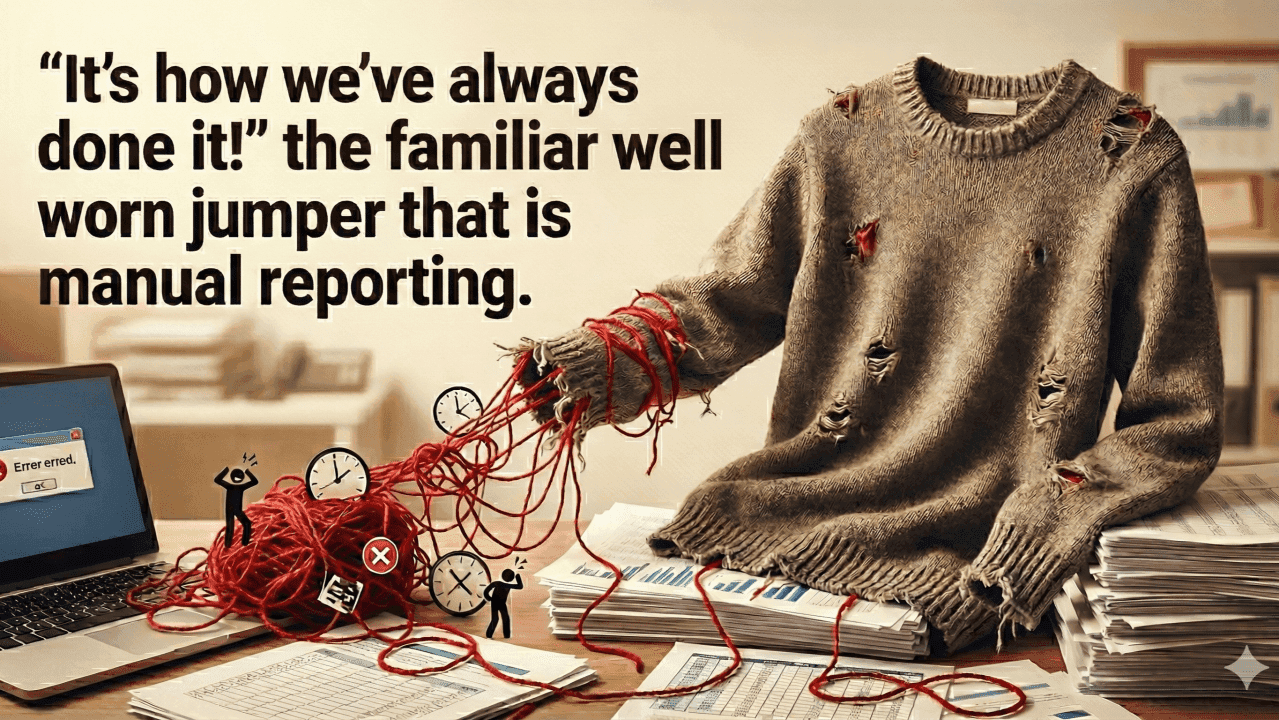
Manual client reporting feels cheap… until it isn’t. Delays, errors, late nights, frustrated teams and confused clients. The hidden costs are stacking up, and most firms don’t even see them.
Across asset and wealth management, manual client reporting persists like a well-worn jumper; Familiar, Comfortable, even reassuring, but you wouldn't wear it out in public and certainly not to a client meeting!
“It’s how we’ve always done it!” Many firms rely on spreadsheets, PDFs and legacy workflows to deliver their client reporting obligations. It often works, just about. Reports are compiled, checked, sent. But beneath the surface, that manual process is quietly bleeding time, introducing risk, and constraining growth.
The Real Cost of People Hours
Every asset manager knows the ritual. Quarter-end hits. Teams scramble to chase data, reconcile spreadsheets, apply formatting, correct errors and produce reports. On paper, it’s just “staff time”. In practice, it’s hundreds of hours spent on repeatable, manual tasks that could have been automated.
- Rework cycles every time data changes.
- Opportunity cost when skilled people are stuck on admin.
- Burnout from compressed reporting cycles.
One mid-size asset management firm we met recently calculated over 600 cumulative staff hours spent each quarter, time that could have been spent adding value elsewhere.
Human Error: A Quiet Reputation Risk
Manual workflows are fragile. Every copy-and-paste introduces the potential for error. Every late spreadsheet update increases the chance of mismatch. And when something does slip through the cracks, the cost isn’t just internal — it’s reputational.
- Clients notice.
- Compliance teams escalate.
- Boards ask questions.
A single incorrect figure can undo years of trust.
Manual Workflows Don’t Scale
Growth is the ultimate stress test. Manual workflows may hold together for a handful of funds or a modest client base, but when the business grows, reporting becomes the bottleneck. Teams can’t scale fast enough. Adding headcount doesn’t fix the brittleness.
- More clients = more risk of error
- More funds = more data manipulation
- More reporting = slower delivery
Strategic Blind Spots
When reports are built manually, they’re treated as outputs, not assets. Data is trapped in PDFs, hidden in spreadsheets, and unavailable for wider use.
A modern reporting infrastructure flips that on its head. Reporting becomes structured, reusable and valuable. It can feed other systems, power analytics, and improve distribution strategies.
How Instinct Helps
INSTINCT helps asset and wealth managers deliver reports faster, with less effort, and more impact. By automating data ingestion, standardising templates, validating data, and making workflows transparent, we remove the drag of manual reporting.
- Fewer hours spent on manual work
- Lower risk of error
- Faster reporting delivery
- More trust from clients
Familiarity isn’t strategy. The firms that thrive are those who treat reporting as a strategic lever, not an operational burden.
If your team is still wrangling spreadsheets at quarter-end, it’s time to talk to Instinct. Because the real cost of manual reporting isn’t in the hours spent, it’s in the opportunities missed.